



“How long will it take, and what will it cost?”
It’s the most reasonable question in the world, and the one any honest development team finds hardest to answer on the spot. Not because we’re being evasive, and not because we don’t know our craft. It’s because a meaningful answer depends on things nobody can fully see at the very start, and the teams that fire back a confident number on day one are often the ones whose projects drift over time and over budget by month three.
There’s a better way to get to a number you can trust, and it starts with software project scoping: a short, deliberate phase before the main build. We almost always begin a project this way. It’s the single most effective thing we do to keep a project predictable, and it tends to lower the total cost rather than add to it.
Why a straight answer is so hard early on
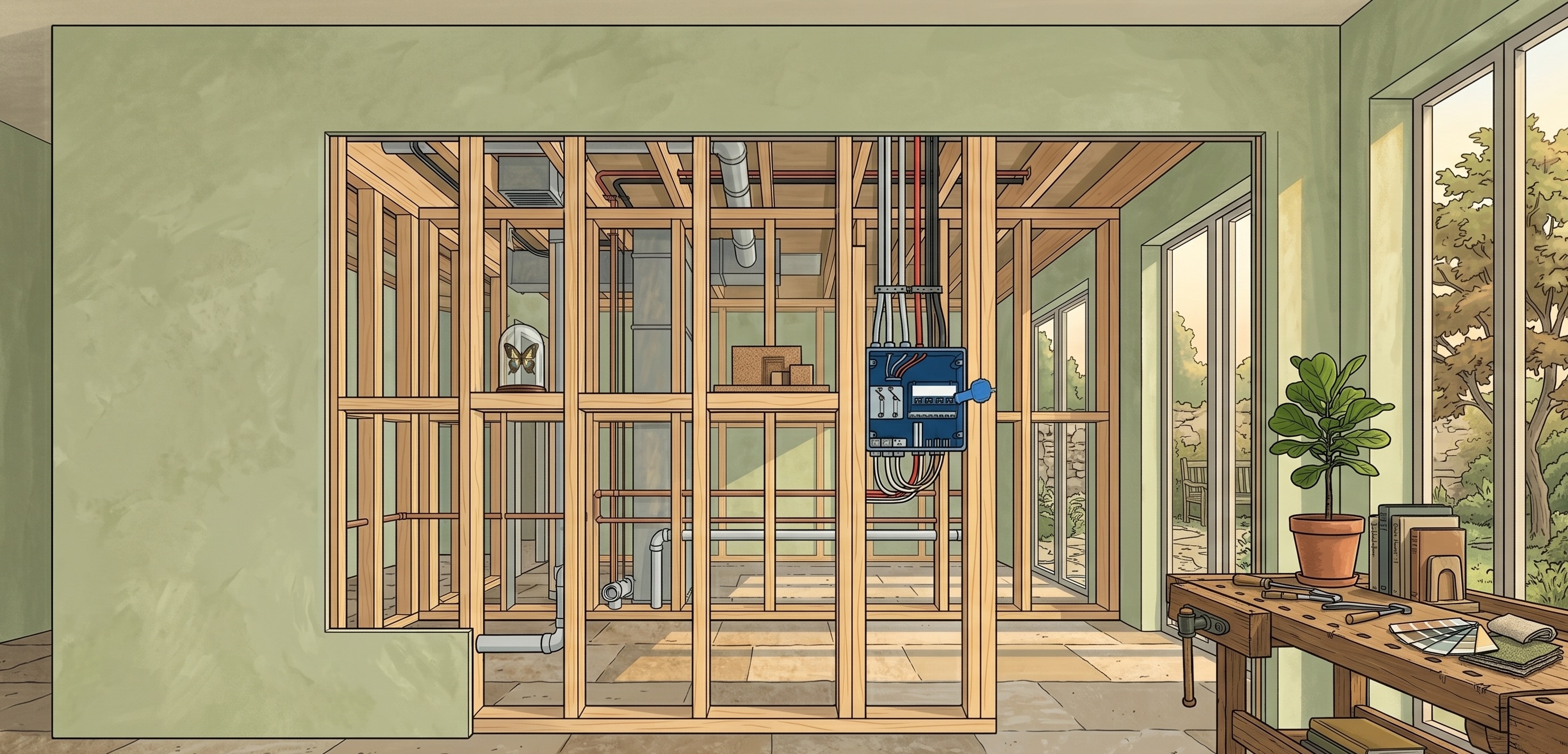
Imagine asking a builder what it costs to renovate a house they haven’t walked through yet. They could guess. But the real answer depends on what’s behind the walls, the state of the wiring, whether the foundations can take the load you have in mind. The guess and the reality can be very far apart, and the gap is rarely in your favour.
Software is the same, with the added difficulty that most of the structure is invisible. A request that sounds simple, “let customers log in and see their orders,” touches how your data is stored, what your existing systems will and won’t share, how many people use it at once, what happens to the accounts you already have, and a dozen other things that don’t show up in the original sentence. None of this means the work is hard. It means the shape of the work isn’t yet clear, and pretending otherwise is how projects go wrong.
What software project scoping actually does
A scoping phase is simply the part where we walk through the house together before committing to the renovation. It’s short, it’s focused, and its whole purpose is to turn unknowns into knowns while doing so is still quick and inexpensive.
In practice, that means understanding your business process before settling on a technical approach: how the work actually flows today, where the friction is, what needs to connect to what, and what success looks like for the people who’ll use the thing every day. It’s the difference between building what was literally asked for and building what the business actually needs, which, more often than you’d think, aren’t quite the same.
The most valuable part is what scoping does to risk. Every project has one or two genuinely uncertain elements, the parts nobody can be sure of until they’re tested. Scoping is where we identify those and, where it’s warranted, prove them with a small proof of concept: a focused test of the riskiest assumption, built early to answer the question everything else depends on. Discovering a constraint in a two-day test is a minor adjustment. Discovering it in the final week of a full build, when everything is resting on it, is a crisis with a price tag.
Why it lowers cost rather than adding to it
Here’s the part that feels counterintuitive. Spending a little time and money up front almost always reduces what the project costs overall.
The expensive problems in software are nearly always the ones found late. A misunderstanding about how a system should behave is cheap to fix in a conversation, more expensive to fix once it’s been built the wrong way, and most expensive of all once it’s live and real customers are relying on it. Scoping pulls those discoveries forward to the cheapest possible moment. You’re not paying extra for scoping. You’re paying far less for the mistakes it quietly prevents.
It also produces an estimate you can actually plan around. After scoping, the timeline and budget are based on a real understanding of the work rather than a hopeful guess, which means fewer surprises, fewer awkward “we’ve found something” conversations, and a number you can take to your own stakeholders with confidence.
The part most people forget: total cost of ownership
The price of building something is only ever part of the story. The bigger number, over the life of the software, is what it costs to run, maintain, and change after launch.
Decisions made in haste at the start echo for years. A system built without understanding how the business would grow can need expensive reworking the moment volumes rise. An approach chosen because it was quick to stand up can become the thing that’s slow and costly to maintain every month thereafter. Scoping is where these longer-term decisions get made deliberately, with your future in mind, rather than by default under time pressure. A well-scoped project doesn’t just cost less to build. It costs less to live with, which is where most of the real money is spent.
What this means for you
You don’t need to arrive with a perfect, fully formed specification. Bringing the goal, the problem, and a sense of what good looks like is plenty. The scoping phase is where that becomes a clear, costed, de-risked plan, and it’s deliberately kept short so you reach that point quickly.
So when the answer to “how long will it take?” is “let’s spend a little time finding out properly,” that isn’t hesitation. It’s the most reliable route to a project that lands on time, on budget, and that you’re not still paying to untangle a year later. The honest estimate is worth waiting a short while for. The confident guess is the one that tends to cost you.
If you’ve got a project in mind and want a clear sense of what’s involved before you commit to anything, that first conversation is exactly where we like to start.
Planning a project?
Contact our team to find out what’s really involved before you commit to anything.
Simon Paul is a Business Solutions and Technology Specialist at Code Brewery who’s spent 25+ years turning business ideas into software that actually earns its keep. He’s seen enough projects to know that the time spent understanding a problem is never the time that’s wasted. Reach out to Simon to talk through what a scoping phase might look like for your next project.
 4.9
4.9  71
71 


