



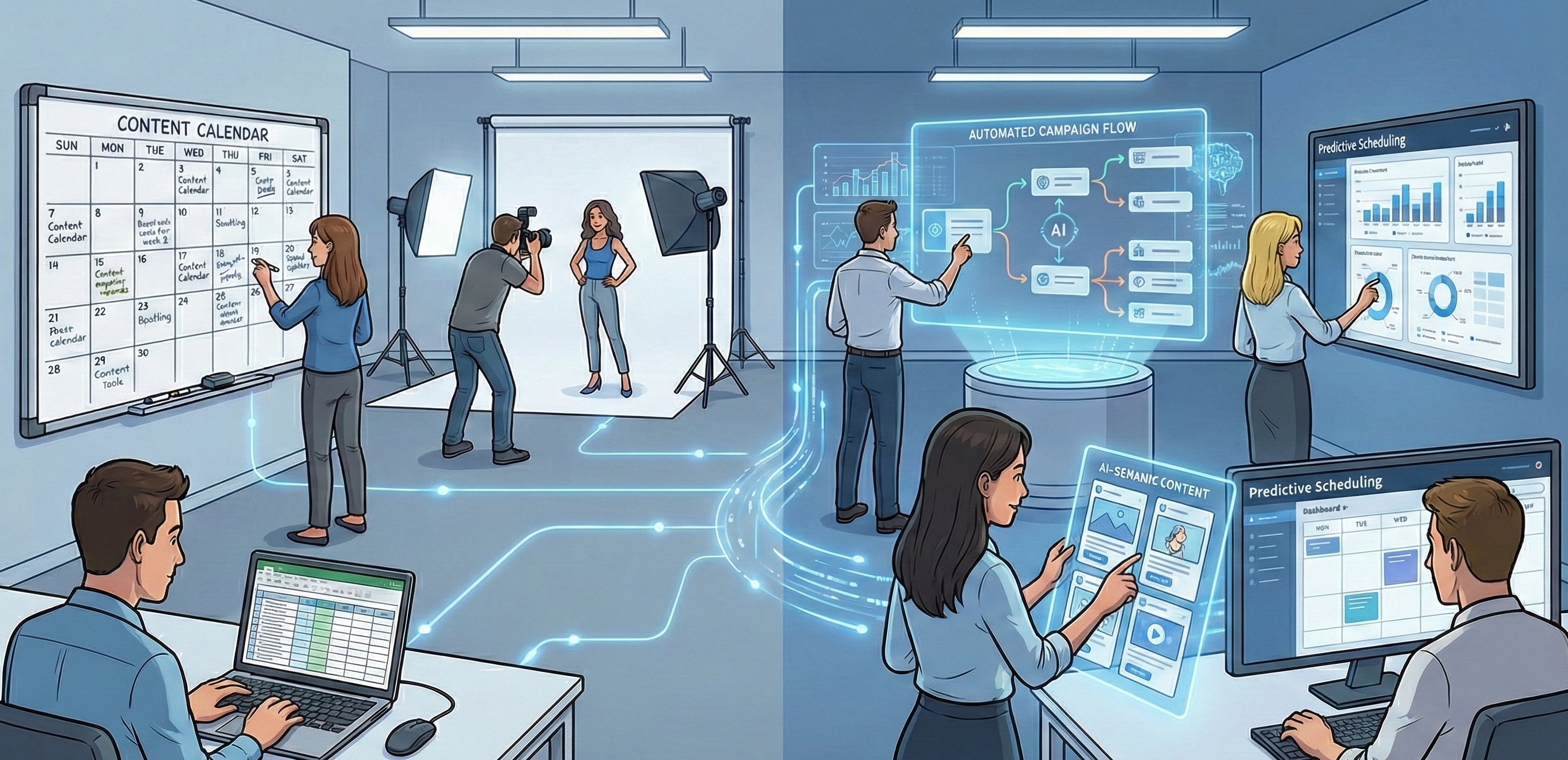
The predictions are everywhere. AI will automate content creation. AI will replace entire marketing teams. AI will make agencies obsolete. But what does AI digital marketing in 2026 actually look like?
Most of these predictions are wrong, or at least badly framed. The more interesting question isn’t whether AI will change digital marketing. It will. The question is how the change will actually unfold, and what it means for agencies navigating the transition.
Here’s a practical view of AI digital marketing in 2026, based on what’s already working, what’s genuinely emerging, and what remains speculation dressed up as certainty.
Content Production Is Already Changing
This isn’t a prediction. It’s happening now.
Businesses are using AI tools to generate social media posts, email copy, blog content, and ad variations at volumes that weren’t practical before. The quality varies enormously, but the volume is real. For routine content that needs to be “good enough” rather than exceptional, AI generation has crossed the usefulness threshold.
What this means for agencies: The value of producing competent, routine content is declining. When clients can generate acceptable social posts themselves, the agency value proposition needs to sit elsewhere. Strategic direction, creative excellence, campaign architecture, performance optimisation; these become more important as basic content production becomes commoditised.
The agencies thriving in this environment aren’t fighting the shift. They’re repositioning around work that requires judgment, creativity, and expertise that AI doesn’t replicate well. They’re also helping clients use AI tools effectively, which is itself a valuable service.
Scheduling and Distribution Are Getting Smarter
AI-powered scheduling tools are moving beyond “post at the optimal time” to more sophisticated approaches: dynamic content selection based on audience behaviour, automated A/B testing at scale, and responsive adjustments based on real-time performance.
The platforms themselves are embedding these capabilities. Meta, Google, and TikTok are all building AI-driven optimisation into their advertising systems. The baseline for “competent campaign management” is rising as the tools handle more of what used to require human attention.
What this means for agencies: The tactical work of scheduling posts and managing basic optimisation is increasingly automated. This isn’t eliminating jobs so much as shifting where human attention creates value. Strategy, creative development, and interpreting results to inform future direction remain human domains. The middle layer of routine execution is where automation is taking hold.
Visual Content Production Is Accelerating
AI-assisted photo and video production is moving from experimental to practical. Tools like OpenAI’s Sora and Adobe’s Firefly are leading this shift. Not for every use case, but for specific applications:
Product photography variations and lifestyle imagery can be generated or modified at scale. Brands are using AI to create seasonal variations, test different contexts, and produce localised content without full photo shoots for each variation.
Video content for social platforms is being AI-assisted in editing, formatting for different aspect ratios, and generating variations. Full AI video generation remains limited, but AI assistance in video workflows is becoming standard.
User-generated content and influencer content is being supplemented with AI-generated alternatives for testing and gap-filling.
What this means for agencies: Production capabilities that required significant budget and time are becoming faster and cheaper. This creates pressure on traditional production revenue, but also opportunity. Agencies that can orchestrate AI-assisted production effectively, maintaining quality and brand consistency while capturing efficiency gains, offer genuine value. The skill shifts from “we can produce this” to “we can produce this well, at scale, with the right tools.”
Personalisation Is Becoming More Practical
True one-to-one personalisation has been promised for decades. AI is finally making it practical for more use cases.
Dynamic content that adapts to user behaviour, preferences, and context is becoming easier to implement. Email campaigns with hundreds of variations. Landing pages that adjust based on traffic source and user signals. Ad creative that shifts based on audience segments.
The Mars Wrigley campaign that processed over 57,000 submissions with personalised responses is an example of what’s becoming achievable. That required significant technical infrastructure, but the underlying capabilities are becoming more accessible.
What this means for agencies: Personalisation strategy becomes more important as execution becomes more feasible. Understanding what to personalise, how to segment audiences meaningfully, and how to measure impact; these strategic questions matter more when the technical barriers to implementation are lower.
What Isn’t Changing (Yet)
Amidst the genuine shifts, some things remain stubbornly human:
Strategic thinking. AI can process data and identify patterns, but defining what success looks like, understanding competitive dynamics, and making judgment calls about brand positioning remain human work. The inputs to strategy might be AI-assisted; the strategy itself isn’t.
Creative leaps. AI generates variations on existing patterns effectively. Genuine creative innovation; the unexpected idea that reframes how people see a brand; remains a human capability. AI is a tool for exploration, not a replacement for creative vision.
Relationship management. Clients hire agencies partly for expertise and partly for partnership. The human relationship, understanding client context, navigating organisational dynamics, building trust; these don’t automate.
Quality judgment. Knowing when something is good enough versus when it needs more work. Understanding brand essence well enough to recognise when AI output misses the mark. These require human expertise that develops over years.
The Agency Opportunity
The agencies best positioned for the next few years aren’t those ignoring AI or those betting everything on it. They’re the ones integrating AI capabilities thoughtfully while doubling down on distinctly human value.
This means:
Efficiency capture. Using AI to do routine work faster, freeing human attention for higher-value tasks. The efficiency gains are real; the question is whether agencies capture them or just pass them through as lower prices.
Capability expansion. AI tools enable smaller teams to deliver work that previously required larger teams or specialist vendors. This can expand what agencies offer without proportional cost increases.
Strategic elevation. As tactical execution automates, strategic value becomes more important. Agencies that can genuinely improve client outcomes through insight and direction have a stronger position than those competing primarily on execution.
Integration expertise. Helping clients navigate the AI landscape, selecting tools, building workflows, maintaining quality; this is itself valuable. Many businesses want the benefits of AI without becoming experts themselves.
AI Digital Marketing 2026: The Realistic Timeline
By the end of 2026, expect:
Widespread adoption of AI-assisted content generation for routine marketing content. This will be normal, not novel.
Significant improvement in AI video and image generation, though still requiring human oversight for quality-sensitive applications.
Embedded AI in major marketing platforms, making some optimisation capabilities table stakes rather than differentiators.
Ongoing uncertainty about intellectual property, copyright, and regulatory frameworks. These questions won’t be fully resolved.
Continued premium on human creativity, strategic thinking, and quality judgment. The tools will be better; the need for expertise in using them won’t diminish.
The transformation is real, but it’s a shift in how work gets done rather than a wholesale replacement of human capability. The agencies that navigate it well will be more productive, more capable, and more valuable to clients. The ones that don’t will find their positioning increasingly difficult to defend.
Planning your agency’s AI strategy?
Contact our team to discuss practical approaches that capture real value.
Simon Paul is a Business Solutions & Technology Specialist at Code Brewery with 25+ years in digital production. He’s watched enough technology transitions to know that the predictions are usually wrong in their timing and right in their direction. Reach out to Simon to discuss how emerging technology fits into your strategic planning.
 4.9
4.9  71
71 


