



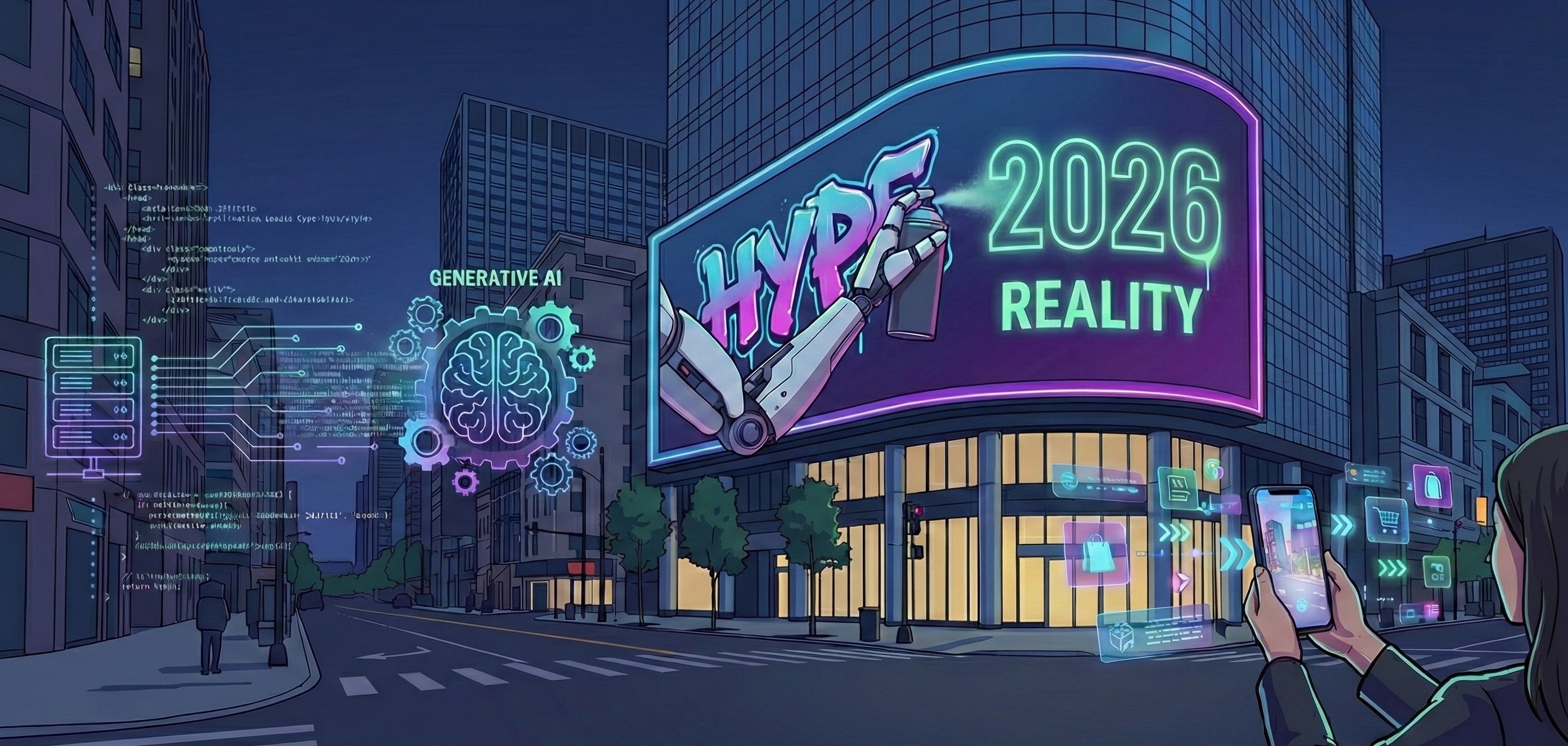
Every month brings another “transformative technology” that’s supposedly going to revolutionise digital campaigns. AI will automate everything. AR will replace websites. Blockchain will reshape how brands connect with consumers.
As the team who builds these technologies into real campaigns, we see the journey from concept to production every day. This isn’t about dismissing innovation; we’re the ones who get excited about making genuinely new things work at scale. But when you’re translating strategy into working code, you develop a clear view of what’s involved in taking emerging tech from proof-of-concept to production-grade campaign.
Here’s what saw in 2025, from the build side of the table.
Generative AI: Useful Tool, Strategic Asset
What you’re hearing: AI can generate entire campaigns, write code, create assets, and dramatically reduce production costs.
What we’re building: AI as a productivity multiplier for specific tasks, integrated thoughtfully into production workflows.
The reality sits somewhere pragmatic. AI tools are becoming standard across the industry, from content generation to code assistance to asset creation. But the output always needs expert review, refinement, and integration.
Where AI genuinely delivers:
- Content variations at scale: Mars Wrigley’s campaign with Amazon Bedrock showed this well, classifying thousands of user submissions and triggering personalised responses
- Rapid prototyping: generating multiple layout options or code approaches faster than manual drafting
- Data analysis: processing campaign analytics and surfacing patterns that would take humans significantly longer to identify
Where it still requires expertise:
- Brand consistency: AI needs careful direction to maintain your client’s tone and visual guidelines
- Technical integration: connecting systems, handling edge cases, and ensuring security still requires experienced architecture
- Creative judgment: knowing when “technically correct” isn’t actually right for the brief
The practical takeaway: Budget for AI tools to accelerate production, not replace expertise. The cost savings come from efficiency gains, and the quality comes from pairing AI capabilities with human judgment.
3D and Anamorphic DOOH: Finally Proven
What you’re hearing: 3D billboards are the next big thing in OOH.
What we’re building: They’re not the future; they’re the present, and the infrastructure is maturing fast.
We’ve been watching this space closely, particularly after ANZ’s Falcon campaign across 2,100+ screens and L’Oréal’s 30-second full-motion execution at Emporium Melbourne. The technology has moved past the “wow factor” phase into reliable, scalable deployment.
What makes 3D DOOH work now:
- Proven asset pipelines: we can automate depth mapping, parallax correction, and format adaptation across different screen types
- Orchestration infrastructure: cloud scheduling handles real-time creative switching across hundreds of locations
- Measurable impact: sites like Emporium Melbourne with 18 million annual visits provide serious reach
What still requires expertise:
- Creative-to-technical translation: not every concept works in 3D, and understanding why saves expensive revisions
- Quality assurance: the illusion breaks with minor errors, so frame-by-frame validation matters
- Sync management: keeping creative consistent across screens in different cities requires proper monitoring
The practical takeaway: 3D DOOH is production-ready for brands willing to invest in proper execution. It’s not experimental anymore, but it does need technical partners who’ve built the infrastructure.
AR and WebXR: Access Matters More Than Features
What you’re hearing: Augmented reality creates immersive brand experiences that drive engagement.
What we’re building: Browser-based AR that works immediately, not native apps that never get downloaded.
The gap between AR’s potential and adoption has always been friction. Asking users to download a specific app for a single campaign interaction is a conversion killer. WebXR changed that equation; AR experiences that run in mobile browsers, no install required.
We’re seeing genuine traction with:
- Virtual try-ons for fashion and beauty brands
- Product visualisation: seeing furniture in your space before purchasing
- Location-based experiences: QR codes triggering AR overlays at physical locations
What differentiates successful AR:
- Instant access: if it takes more than two taps, engagement drops dramatically
- Clear utility: the experience needs to solve a user problem or remove friction from decision-making
- Performance: nothing kills immersion faster than lag or rendering glitches
The practical takeaway: AR works when it removes friction from decision-making. Build for browsers, not app stores.
Sometimes the Quiet Wins Are the Biggest Wins
Here’s something worth mentioning: some of our favourite projects are the ones that never make headlines.
The headless CMS that let a creative team update a multi-market campaign in real-time, enabling them to respond to a cultural moment within hours instead of days. The progressive web app that loaded so fast on patchy mobile networks that conversion rates jumped 40%. The analytics integration that surfaced insights mid-campaign, letting the media team optimise while the campaign was still live.
These don’t photograph well. They’re hard to explain in award submissions. But they’re often what makes the difference between a campaign that looks great and one that delivers extraordinary results.
This isn’t “boring tech versus exciting creative.” The best work is often both; a brilliant creative concept, executed on rock-solid technical foundations. But it’s worth remembering that infrastructure, performance, and integration can be just as strategic as the front-end experience.
We love building genuinely innovative experiences. We also love building the systems that make brilliant creative ideas work flawlessly under pressure.
Understanding the Implementation Landscape
Different technologies sit at different points in the maturity curve. That doesn’t mean any of them are off the table; it means they require different levels of investment, partnership, and risk tolerance.
Production-ready (lower implementation risk):
- AI-assisted content generation and personalisation
- 3D DOOH across established networks
- Browser-based AR experiences
- Real-time campaign analytics and optimisation
Emerging (higher technical complexity, proven at smaller scale):
- Blockchain for verifiable digital ownership and loyalty programmes
- Spatial computing experiences (following Apple Vision Pro’s launch)
- AI-generated video content at campaign scale
- Advanced biometric integration for personalised experiences
Experimental (significant development investment, unclear adoption):
- VR for mass-market consumer campaigns
- Web3 integrations beyond crypto-native brands
- Voice-first shopping experiences
- Fully automated campaign creation
The key isn’t whether to use emerging tech; it’s understanding what level of partnership and investment each tier requires.
A Framework for Evaluating New Tech
When your team is exploring a technology for a campaign, here’s how we assess what’s involved:
1. Does it solve a real problem?
Not “is it cool” but “does it remove friction or create genuine value for the end user?”
2. What’s the adoption barrier?
Special hardware, app downloads, and complex setup all reduce who’ll actually use it. Lower barriers mean broader reach.
3. Can you measure success?
If you can’t track meaningful engagement or conversion, you can’t prove ROI or optimise mid-flight.
4. What’s the infrastructure maturity?
Cutting-edge often means “needs significant development to handle production load.” Early adoption has costs, but also creates competitive advantage when it works.
5. Who’s your technical partner?
This matters more than whether they’ve built your exact use case. Look for teams with a proven track record across emerging technologies, solid systems and processes for managing complexity, and the experience to know when something’s almost ready versus truly production-grade.
The best innovations happen when brilliant creative concepts meet technical partners who can actually execute them reliably. If you’re going to push boundaries, and you should, do it with a team who has the depth of experience to navigate the unknowns.
What We’re Seeing in Active Development
Based on what we’re building and the briefs crossing our desk:
High demand right now:
- AI as a production accelerator across content and code
- 3D DOOH continuing to scale and become more accessible
- Browser-based AR for product visualisation and try-ons
- Real-time personalisation using first-party data
- Headless architecture for omnichannel campaign delivery
Increasing enquiries:
- Spatial computing experiences as hardware becomes more accessible
- Blockchain for loyalty programmes and verifiable digital assets
- AI-generated video for campaign content
- Advanced sentiment analysis for real-time campaign adjustment
Worth exploring with the right brief:
- VR for high-value product experiences (automotive, real estate, luxury)
- Voice integration beyond basic assistant functionality
- Web3 community engagement for appropriate brands
The technology landscape shifts constantly, but the fundamentals remain: the best tool is the one that solves your client’s problem reliably, at the right cost, with measurable outcomes.
The Bottom Line
Innovation for innovation’s sake is a luxury most campaigns can’t afford. But genuine innovation, technology that solves real problems, delivers measurable results, and actually works under production pressure, that’s worth pursuing.
Our role is to help you understand what’s involved in making each technology work in production. Bring us your ambitious ideas; we’re here to figure out how to build them properly, whether that means cutting-edge technology or proven tools used brilliantly.
Sometimes the answer is “this needs more development time.” Sometimes it’s “we can make this work, but here’s the investment required.” And sometimes it’s “there’s a simpler solution that’ll work better.”
That’s the conversation worth having before committing budget and timeline to any technology, new or established.
Ready to explore emerging technology for your next campaign?
Contact our team to discuss how technology, new or proven, might work for your specific requirements.
Simon Paul is a Business Solutions & Technology Specialist at Code Brewery who’s spent 25+ years taking ambitious creative concepts and turning them into production-grade digital experiences. After building everything from complex web platforms to interactive campaigns that push technological boundaries, he’s developed a reliable sense for what’s involved in making both emerging and established technology work at scale. Reach out to Simon to discuss how technology might work for your next campaign.
 4.9
4.9  71
71 


