AI Integration Services in Sydney

AI triage, drafting, document search and data extraction, built in Sydney into the systems your team already uses, with a person checking the work wherever it matters.
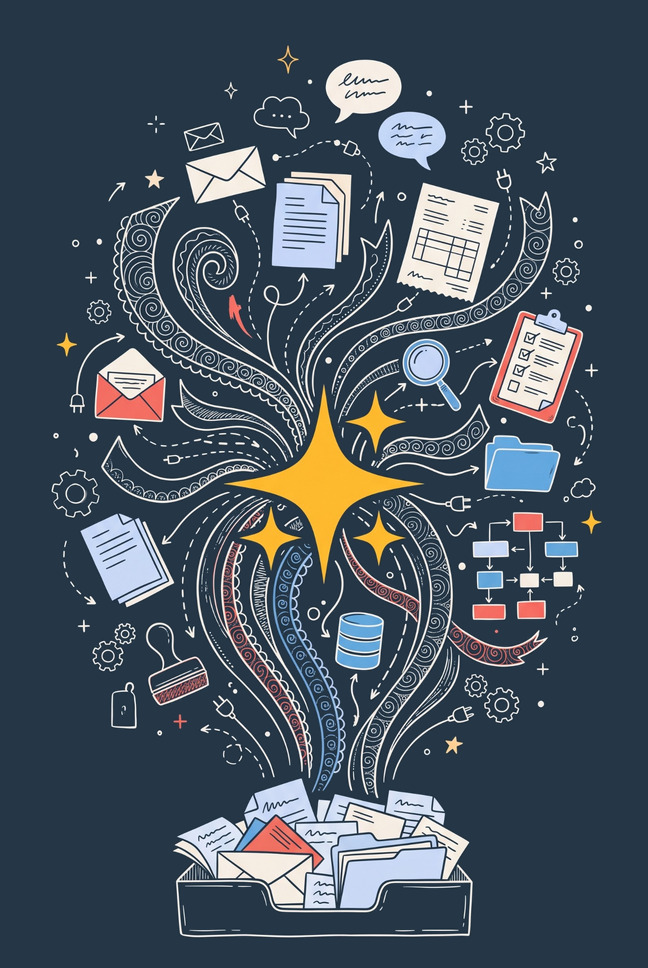
Doodle illustration of envelopes, documents, speech bubbles, a magnifying glass and a checklist swirling around a yellow AI sparkle and rising out of a desk in-tray piled with incoming paper

What do we build with AI?

From a model that sorts the support inbox to an agent that checks supplier invoices against purchase orders, this is the AI work we do.
Request Triage

Request Triage

Email, web forms and chat read as they arrive, sorted by topic and urgency, and passed to the right person with the customer's history attached. Routine questions get an answer from approved material and anything unusual goes to a person, all in the inbox or helpdesk the team already uses.
Drafting for Review

Drafting for Review

Replies, quotes, reports and letters drafted from your own records and templates, for someone on the team to check, edit and send. Nothing reaches a customer until a person has approved it. Drafting suits work with a house style and plenty of past examples to draw on.
Answers From Your Documents

Answers From Your Documents

Staff ask a question in their own words and get an answer from your policies, manuals, contracts or past jobs, with a link to the source. A long case file comes back as a one-page summary. Nobody gets an answer from a document they could not open themselves.
Data From Documents

Data From Documents

Invoices, forms, delivery dockets and certificates read whatever their layout, with the figures pulled out and checked against what your systems already hold. Anything that does not match goes to a person, and nobody re-keys the rest.
Agents, Where They Fit

Agents, Where They Fit

An agent is given a goal and a set of tools and works out the steps itself, such as checking an invoice against its purchase order and drafting the query. It suits work where the path changes from case to case, and is overkill when the steps never change.
Hosted or Local Models

Hosted or Local Models

Hosted models such as GPT, Claude and Gemini lead on capability and charge per use. Free open-weight models such as Llama, Mistral, Gemma, Qwen, DeepSeek and gpt-oss can run on your own server, so no data leaves it. One project can use both, matched to each task.
Managed or Local RAG

Managed or Local RAG

RAG is how an AI answers from your documents: it searches them first, then writes from what it found. Managed RAG runs on a cloud service such as Azure AI Search or Amazon Bedrock Knowledge Bases. Local RAG keeps the index on your own hosting, using tools such as pgvector or Qdrant.
Integration With Your Systems

Integration With Your Systems

Middleware that connects an AI model or product to the CRM, the job system, Xero or MYOB and SharePoint, with access limited to what each task needs. It is usually the largest part of the project, for the reasons in Generative AI in Production.
Guardrails & Support

Guardrails & Support

Tested against your own past cases before launch, with a log of every step, a person's approval for anything that reaches a customer, and defences against instructions hidden in email. Models change often, so we retest after each update and track accuracy and running costs.

Hosted and Open-Weight Models

The hosted models most businesses already know, and the free open-weight models that can run on your own server.

Hosted models and platforms

  • OpenAI GPT
  • Claude
  • Gemini
  • Microsoft Copilot
  • Azure AI
  • Amazon Bedrock

Free open-weight models and local tools

  • Llama
  • Mistral
  • Gemma
  • Qwen
  • DeepSeek
  • gpt-oss
  • Ollama
  • Hugging Face
The First Question

Automation or an Agent?

Automation

When the steps are the same every time, plain automation does the job. A form comes in, a record is created, an email goes out, and a report lands in someone’s inbox on Monday morning. Power Automate, Zapier, n8n or a small scheduled script handle this for less money, and they behave the same on the thousandth run as on the first.

Some steps need a little reading, such as pulling a date out of an email or summarising a long thread. The AI built into Microsoft 365, Google Workspace or your helpdesk can often do that inside the same automation, quick to set up and maintained by someone else.

An Agent

An agent earns its place when the work needs judgement about what to do next: reading a request, checking it against your records and rules, and choosing the next step. A hosted model from OpenAI, Anthropic or Google, or a free open-weight model such as Llama or Mistral run on your own server, does the reading and writing. Code written for the job does the rest: middleware that gives it access to your CRM and documents, the screen where staff review its work, and the rules about what it may do alone. Some of the major cloud providers run the hosted models from Australian data centres, which matters when information has to stay onshore.

Which one fits comes out of scoping, once we know where the data lives, how sensitive it is and how much a person needs to check. Many workflows turn out to be automation with a single agent step in the middle. More on that in What Does “Agentic AI” Actually Mean for My Business?

How Does an AI Project Run?

Every project we run follows the same four stages. On an AI project the open question is how well it handles your actual cases, so it is tried on them early, before most of the build.

Scoping

A short first phase picks one process, finds where its data lives and who is allowed to see it, and agrees what a good result looks like. We gather a few hundred past cases where the right outcome is already known, because without them there is nothing to measure the AI against. It is where the route gets chosen, from plain automation to a custom build, along with whether the model and the document index are hosted or run on your own servers. It produces a technical approach and a realistic estimate.
1

Design and Build

The connections to your systems, the screen where staff review the AI’s work and the log of what it did are built first. The AI then runs in draft mode on real work, with a person checking every output before anything reaches a customer, so you see how it performs while changing course is still cheap.
2

Testing

Our own testers run it over the past cases and the awkward ones: a scanned page upside down, an email that mixes two requests, a message that tries to give the AI instructions of its own. We measure how often a person has to change what it produced, and test again whenever the instructions or the model change.
3

Launch and Support

It goes live on a narrow job with a person approving, and takes on more as the numbers show it can. After launch comes monitoring, cost tracking, model updates and the adjustments that keep it accurate as your business changes.
4

What Drives the Cost?

A number given before anyone has seen where the data lives is a guess, and the model itself is rarely the expensive part. These four things move an AI estimate most, and once they are clear we are comfortable working to a fixed price for the build. Model fees grow with every request, so running costs are estimated alongside it. If a chatbot has already given you a number, bring it along: When Your AI Says One Thing and We Say Another explains why the two often differ.

Data Access: Where the information the AI needs lives, whether those systems offer a way in, and how tidy the data is.

A Person in the Loop: How much a person reviews before anything goes out, and the screens and approval steps that review needs.

Privacy and Location: Whether personal or confidential data is involved, and whether it calls for a model and document index on your own hosting.

Checking the Output: How results are measured before launch and monitored after it, and what happens when the AI gets one wrong.

Why an Australian Studio

About Code Brewery

We are based in Sydney and build for organisations across Australia. Our working day overlaps with every Australian business day, so when the AI starts misreading a new supplier’s invoices on a Monday morning, someone who built it is already at work.

Our team covers the whole job: senior developers, project managers, quality assurance testers and digital designers. AI work needs all of them, because most of it is integration, testing and the screens people use to review what the AI produced. We work for businesses that come to us directly, and as the production team behind a number of creative and digital agencies.

Government and enterprise buyers can check the paperwork before the first meeting. Code Brewery is an Advanced supplier on the NSW Government ICT Services Scheme (SCM0020), and is rated Very Strong on the ProcessUnity Risk Index, the highest of its five ratings.

Stay connected With Us

Get In Touch

*Required. Please enter your full name.
*Required. Please enter your company name.
*Required. Please enter a valid email.
*Required. Please enter a valid phone number.
*Required. Please select a project type.
*Required. Please enter a message.
*Please check the reCAPTCHA box before submitting.